Loyalty card
Spend earns points, points unlock a standing discount.
A card you switch on for one client at a time. Visits earn points in proportion to what was spent, the total unlocks a tier, and the tier takes a fixed percentage off every future visit. It is not a points wallet: points are never spent on anything, so there is nothing to redeem and nothing you owe — a tier simply lowers the next price.
The ladder lives on Loyalty card, under Retention with the reminders and the recalls: all three are ways of keeping a client, rather than settings of the business. Included from the Growth plan.
Setting up the ladder
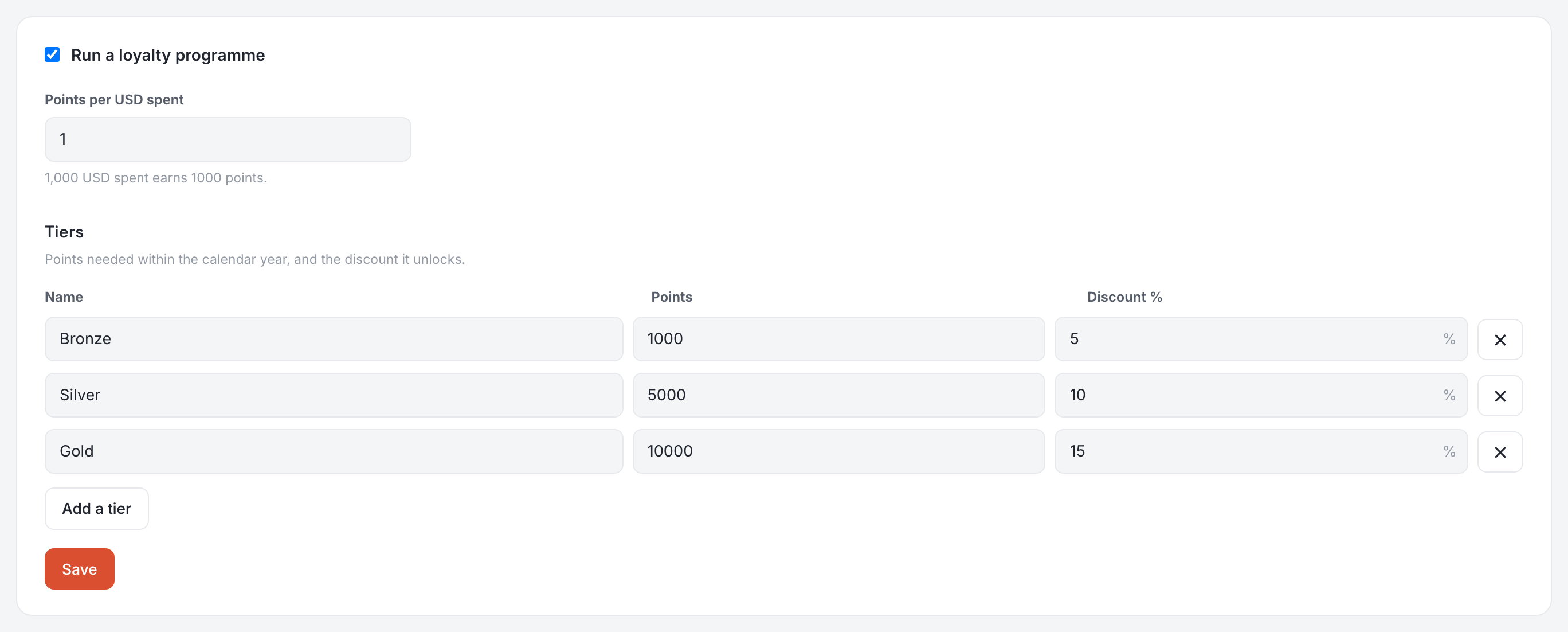
- Run a loyalty programme — the switch. Nothing happens for any client until you also activate their card, and it cannot be saved without at least one tier.
- Points per THB spent (your own currency) — the rate. At 1, spending 5,000 earns 5,000 points; the line under the field spells out what 1,000 buys. Lower it if 1:1 gives you five-digit thresholds, raise it for a month of double points without rewriting the ladder.
- Tiers — Name, Points and Discount %, one row each, with Add a tier under them. Three rungs is typical; two or five work just as well.
The ladder belongs to the business, not to the desk that wrote it: a group has one card, so a client carries one balance across every location. Editing it is for admins and office staff — the people who take the money set what it buys, the same rule as the deposit terms.
The discount stacks on top of packages: a package is already sold below list, and the tier comes off that price. You set the ladder knowing this.
Giving a client the card
Open the contact in Contacts and press Activate in the loyalty block; Deactivate is in the same place. If they have an email address they receive their card straight away, with a link to their own page. No address is not a failure — a walk-in who left only a phone number still earns, and the desk can still read the balance.
That link (/card/…) is the same in every message and always current. An email states a number that was true the day it was sent; the page never is out of date, which settles the argument at reception before it starts. No login — the link is the proof.
After a visit that earned points, a short note tells the client what they earned, their total, and what is left to the next tier. It is sent by the nightly sweep that closes attended appointments, so it follows a visit left to close on its own — the usual path. Marking an appointment kept by hand scores the points but sends no note.
How points are counted
- Only appointments marked kept (or recovered) count. A cancellation or a no-show takes its points straight back, on its own.
- What counts is the price on the appointment, recorded at the time. Raising a service price later never revalues a past visit.
- An appointment left without a price earns nothing — an “On request” service where nobody filled the amount in. The contact says how many there were, so you can always explain a total.
- Nothing is stored or decremented: the balance is worked out from the visits each time it is shown, which is why three screens can never disagree about it.
The year, and the year of grace
Points run from 1 January to 31 December. The tier earned in a year is honoured through the whole of the following one — the airline rule — so the reset is a fresh start rather than a punishment: the client accumulates from zero while keeping what they had. The contact says when a tier is being held that way. A demotion still happens, twelve months later, which is what makes it acceptable. It also gives you the strongest line the product has: “800 points to keep Gold”.
Setting a tier by hand
On the contact, Set tiergrants one directly — the regular who deserves it, the owner's sister. It is never overwritten by the calculation, and Follow the points hands them back to it. It leaves a trace: who, when, and the reason you typed in Why this tier?, shown next to the tier. A permanent discount is a front-desk call, so it is one that gets recorded.